


Hello everyone, and welcome to this week’s newsletter. It has been a big few days for the Innovator Founder Visa community, so we are starting with the news that has been on everyone’s mind, then catching you up on everything else you may have missed.
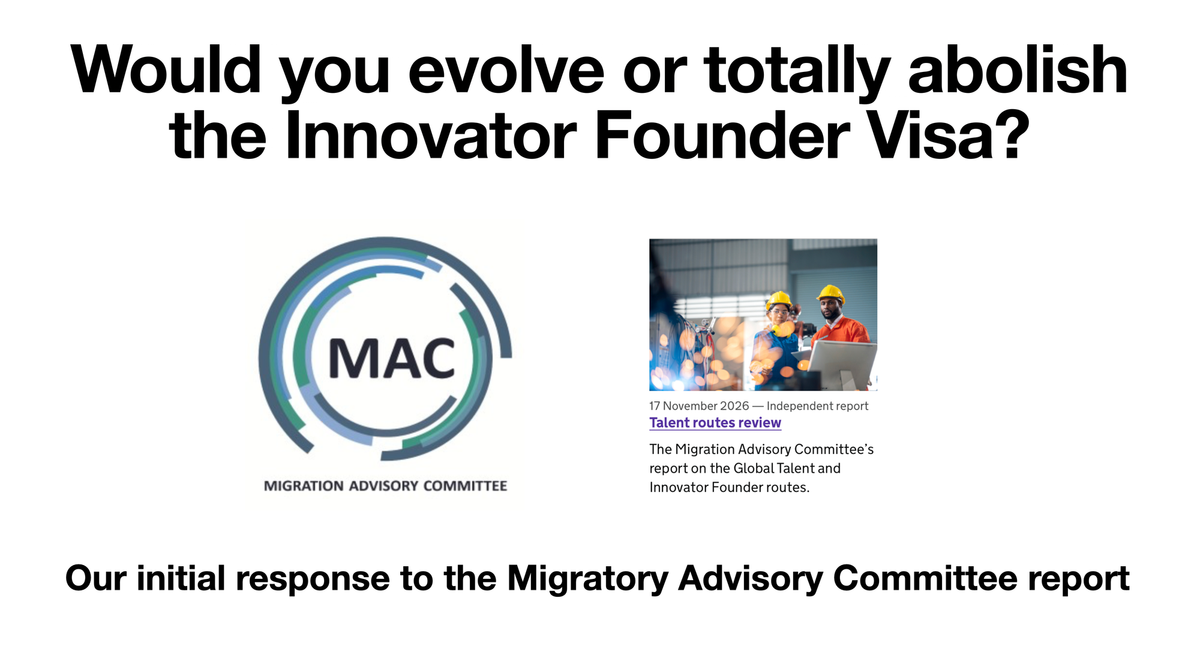
Our response to the MAC report on the IFV
If you have seen the letters “MAC” on your feed this week, here is what it is all about. The Migration Advisory Committee is the government’s independent advisory body on migration. Over recent months it has been reviewing the talent visa routes, speaking to the Home Office, endorsing bodies, legal partners and applicants along the way. Its report landed earlier this week, and it asks a simple question: are the Global Talent and Innovator Founder routes working?
Its answer for Global Talent is that the route is largely meeting its objectives. For the Innovator Founder route, it says it is not, and it recommends that the government either abolish the route or reform it substantially so that it becomes much more selective.
Before anyone panics, there is one important thing to remember. This is advice, not a decision. Nothing has been confirmed, and the government still has to decide what, if anything, it will do with the recommendations.
We have published our initial response, and we want to be clear that it is a balanced one. There are recommendations we agree with, because a route less than four years old should keep evolving. But on the headline conclusion, we think it is far too early to call the route a failure. The route only launched in April 2023, and an average applicant takes around five years to reach the point where they can apply for settlement. Judging it now is a bit like judging a tree before it has had time to fruit.
We also have concerns about how the data has been read. Many of the comparisons are with UK resident founders, who already have their networks, their customers and their understanding of British business culture. Founders who have moved here from abroad are building all of that from scratch, so expecting the same pace is not a fair test. Numbers matter, but without context they can mislead.
Then there is the question of innovation itself. Richard explains that innovation works much like investing. You cannot pick the winners in advance, so you back a portfolio, with many low risk, low return projects and a few high risk, high return ones. Because the big successes are rare, the average and the median will always look modest. His view is that the fairer measure is to look at the top ten percent and ask whether the net gains are far greater than the net investment. If they are, the programme should be seen as a success.
Our conclusion is that some change would help, but that scrapping the route would be, as the old British saying goes, throwing the baby out with the bathwater.
Please do read the full article. It goes into much more depth than we can here, and it links to the MAC report itself so you can read it for yourself:
 Innovator International
What our community has been telling us
We have been touched by the messages that have come in since the article went live. One of our regular webinar attendees wrote to thank the team and said he was close to speechless at the conclusion. His point was that high growth businesses often take a decade or more to turn a profit, and that Instagram had no revenue at all when it sold for a billion dollars. He also noted that the report itself admits a small number of exceptional firms may matter more than the average, yet still judges the route on that average.
What struck us most was his closing thought. He hopes this does not stifle the progress of those trying to do good for the UK, and he reminded us that founders bring far more than a fiscal impact. They bring culture, care and education too, fields that can be modestly paid yet sit at the heart of our communities.
The same conversation has been running in our Facebook group, where one member asked what everyone made of the recommendations and how they might affect people already on the route or thinking of starting out. Honest, thoughtful questions like that are exactly what the group is for.
Join our Facebook group here:
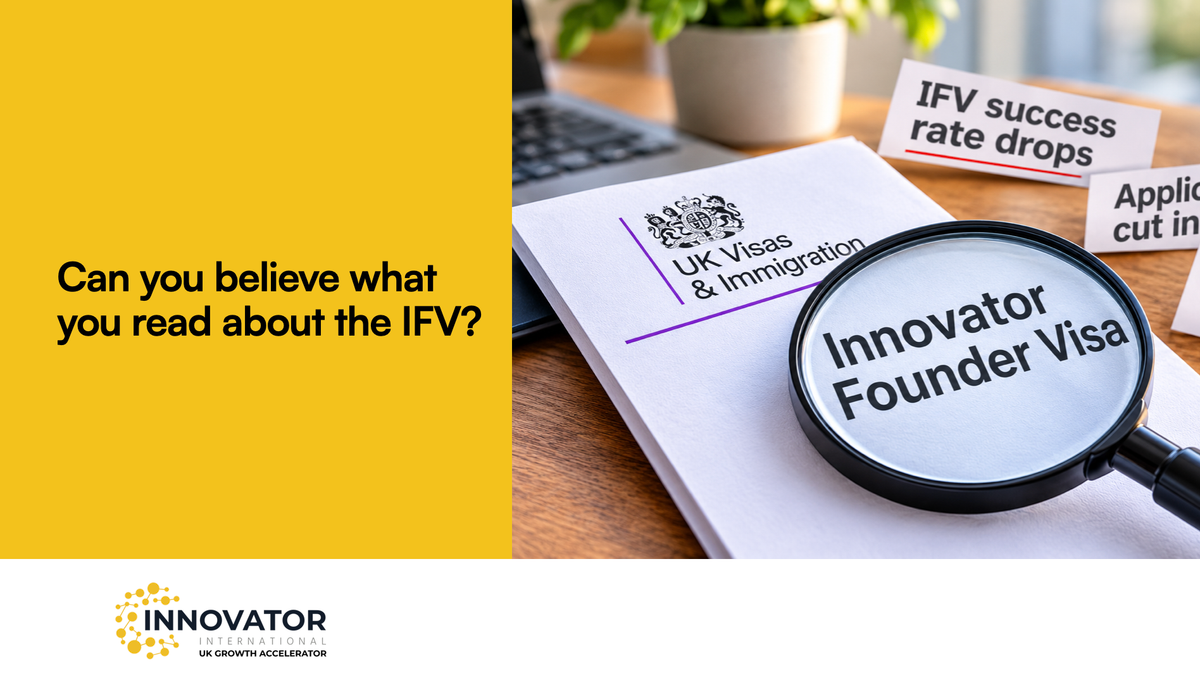
Fact or headline? Join us live next Wednesday
If a worrying headline about the route has made your stomach drop lately, this one is for you. On Wednesday 25th November, 10:00 to 11:00 (UK time), Richard is hosting a one-off live session called “Can you believe what you read about the IFV?”, which runs in place of our November AI webinar (that one has moved to January).
Many of the stories doing the rounds are built on outdated or incorrect assumptions, so Richard will take them on head first. He will bring updated figures and set them alongside the statistics published by the Home Office, look at current trends, and share real information from an active Endorsing Body. And because it is live, you can bring along any headline that has worried you and ask away.
It is open to future applicants, founders who are mid-application and endorsed founders alike. Places are free, but you need to register through Zoom. If you know another founder who has had that same sinking feeling, please pass this on to them. If you cannot make it live, we will be recording the session and sharing a recap on Innovator Pulse for paid members.
 Innovator International
How to keep your business ready for whatever changes next
This one feels timely, given the week we have had. Richard looks back at a Lancashire packaging firm that went into administration after the 5p carrier bag charge arrived, and asks whether innovation could have saved it. His answer is that change has never been polite, and the founders who last are the ones who keep asking where their market is heading and what they would do about it.
The article includes a handful of questions worth asking yourself regularly, and Richard’s IFARA philosophy: Insight, Foresight, Acumen, Resilience and Adaptability. It is a lovely, practical read whatever stage you are at, and a good reminder that adapting is a habit rather than a one-off.
 Richard Harrison

In case you missed last week’s newsletter
Our previous edition, “Grey skies, tidy folders and a founder worth revisiting”, is still well worth a look. It covered how to start keeping an evidence trail from day one, the first instalment of our new “Where Are They Now?” series with Hari Sekar of Fusion Kitchen UK, and a guide to surviving and enjoying a British winter.
 Innovator International

Thank you, as always, for being part of our community. Whatever the headlines say, you are not facing them alone. See you next week!


