

When you're bringing your business to the UK, you're essentially starting from zero in terms of local connections. You might have a brilliant product, years of experience, and a solid track record back home, but in the UK, nobody knows who you are yet.
That's precisely where LinkedIn becomes invaluable.
While other social platforms have their place, LinkedIn is the only one purpose-built for exactly what you need right now: establishing professional credibility, finding the right connections, and building genuine business relationships in a new market. Here's how to use it strategically from day one.
Start With Your Profile Foundation
Before you start connecting with anyone, your profile needs to communicate three things instantly: who you are, what you do, and why it matters in the UK context.
Your headline shouldn't just be your job title. Instead of "CEO at TechCo," try something like "Building AI-Powered Solutions for UK Healthcare | Expanding to London." It immediately positions you as an active player in the UK market.
The profile photo matters more than most founders think. This is the UK. Professional doesn't mean stuffy, but it does mean polished. A clear headshot with good lighting in professional attire is non-negotiable. And yes, use a UK location in your profile once you've moved. It signals you're here to stay, not just testing the waters.
In your "About" section, tell your story, but make it relevant to your UK audience. Why did you choose the UK market? What problem are you solving here specifically? What makes your approach different? This isn't a CV, it's a conversation starter.
Finding the Right People (Without Being Random)
Here's what not to do: connect with everyone in your industry indiscriminately. Mass connection requests with generic messages get ignored or worse - marked as spam.
Instead, be strategic about who you're connecting with. Start by identifying the specific types of people who could genuinely help your business right now. That might be potential customers, complementary service providers, industry experts, or other entrepreneurs who've walked your path.
Use LinkedIn's search filters intelligently. If you're a fintech startup, search for "fintech" within specific UK locations, then filter by connections you already have in common, or by companies you'd like to work with. Join UK-based industry groups where your target audience actually congregates, not just the massive generic ones with millions of members where your posts disappear into the void.
When you find someone worth connecting with, always personalise your invitation. Reference something specific: a post they wrote, a mutual connection, or why you think connecting makes sense for both of you. "I noticed you're also working on sustainable supply chain solutions in the UK so it would be great to connect and share insights" works infinitely better than the default "I'd like to add you to my professional network."
How We Use LinkedIn (And What You Can Learn From Us)
Let's look at a real example. Take a look at how Innovator International approaches LinkedIn - it's worth studying because we are targeting exactly the audience you're part of: international entrepreneurs building businesses in the UK.
Notice how our posts aren't just promotional announcements. We aim to share practical resources (like our business plan guide), celebrate community achievements, and create engagement through simple polls and questions. We are not trying to be a faceless corporation, we are building a community.
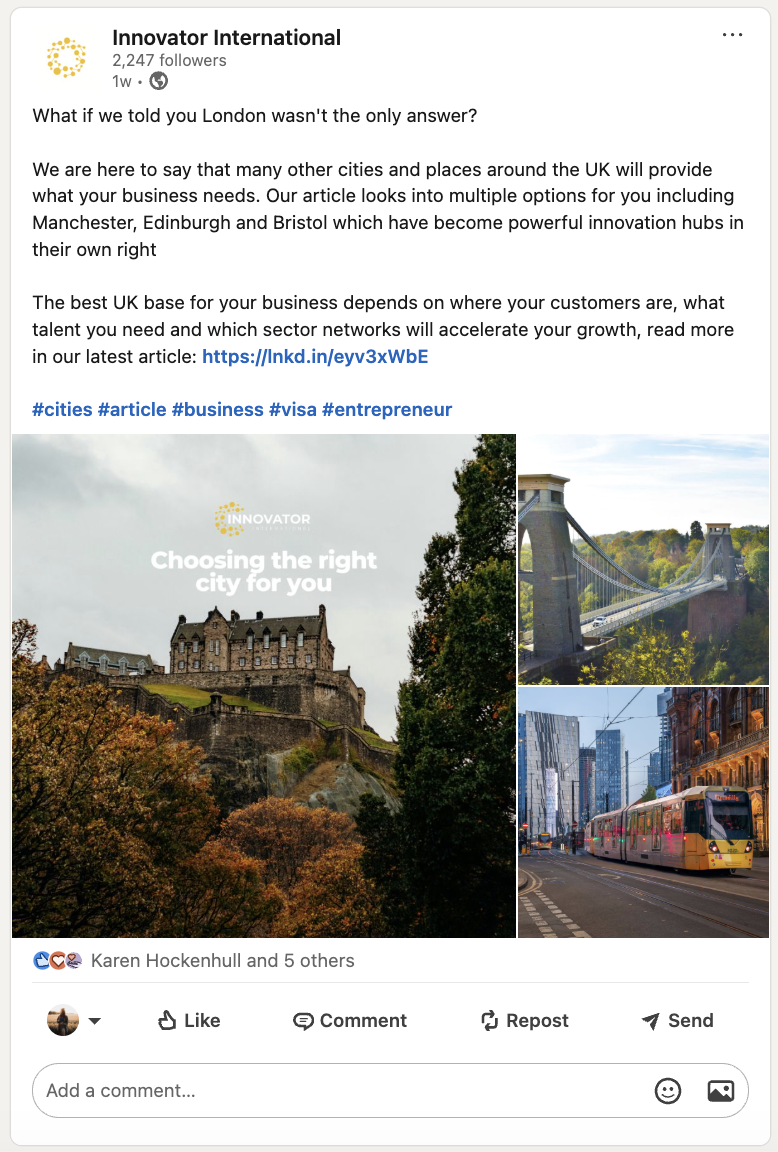
When we posted about National Pizza Day with a poll about toppings, it wasn't random. It's an easy way to keep our audience engaged between more serious posts about visa routes and business strategy. The mix matters: too formal all the time and people tune out, too casual and you lose credibility.
We also love to share testimonials and stories from our community members, this provides social proof while making our members feel valued and visible.
Posting as a Business: Quality Over Volume
The biggest mistake founders make on LinkedIn is posting inconsistently or, worse, churning out generic content that sounds like it came from a marketing template.
Your posts should serve one of three purposes: educate, engage, or inspire. Educational posts share insights from your expertise - lessons you've learned, common mistakes in your industry, how-to guides. Engagement posts ask questions, share interesting developments, or start conversations. Inspirational posts (use sparingly) share genuine wins, challenges you've overcome, or behind-the-scenes glimpses of building your business.
Here's what actually works:
Write like a human, not a corporate press release. First-person perspective, contractions, personality - these aren't unprofessional on LinkedIn. They're authentic. "We're excited to announce..." is fine occasionally, but "Here's what we learned the hard way this week..." is far more engaging.
Tell stories, not just facts. Instead of "We launched our new feature," try "Three customers told us the same problem last month. It kept me up at night. So we built this." People connect with narrative, not feature lists.
One focused idea per post. LinkedIn isn't the place for your 2,000-word manifesto (save that for your blog and share a excerpt). Get in, make your point clearly, and get out. 150-300 words is often the sweet spot.
Use line breaks generously. Solid blocks of text die on LinkedIn. Break your content into scannable chunks. Each paragraph should ideally be 1-3 lines maximum on mobile. White space is your friend.
End with a question or call to action. Not "DM me for more info" (which feels salesy), but genuine questions that invite response. "What's your experience been with this?" or "Anyone else finding this challenge in their business?"
Building Your Team Through LinkedIn
When you're expanding your team in the UK, LinkedIn becomes your primary recruitment tool, but it works differently than traditional job boards.
First, make your company page compelling. This is where potential candidates will go to vet you before applying. Keep it updated with regular posts, clear information about your mission and culture, and content that showcases what it's actually like to work with you.
When posting job openings on LinkedIn, skip the corporate HR speak. Your job posts should read like you're describing the role to a friend. What's the actual challenge this person will tackle? What will they learn? Why is your company interesting beyond just "competitive salary and benefits"?
Don't limit yourself to formal applications. When you see someone with the right background, reach out directly. "I see you've been working on X at Y company. We're building something in this space and looking for someone with exactly this expertise. Would you be open to a conversation?" This direct approach works remarkably well in the UK, especially for startups where culture fit matters as much as skills.
Recruiters can help, but for your first few critical hires, consider doing the outreach yourself. Candidates appreciate hearing directly from the founder, and it signals that these roles matter.
Connecting With the UK Business Ecosystem
LinkedIn is where you'll find the broader support network you didn't know you needed: mentors, advisors, potential investors, accelerator programmes, and government support services.
Search for and follow UK government accounts like the Department for Business and Trade, Innovate UK, and your local LEP (Local Enterprise Partnership). They regularly post about funding opportunities, events, and support programmes specifically for businesses like yours.
Join LinkedIn groups focused on UK entrepreneurship. Some active ones include "UK Startups & Entrepreneurs," sector-specific groups like "UK FinTech Founders," or location-based ones like "Tech London Advocates." Participate genuinely in discussions - don't just lurk or drop links to your website.
Follow and engage with UK business journalists and publications. When they post about your industry, thoughtful comments can get you noticed. TechCrunch UK, Business Insider UK, and industry-specific publications all have active presences.
Connect with other Innovator International members on LinkedIn. They understand exactly what you're going through because they're doing it too. This peer network often becomes your most valuable resource with people who can recommend accountants, commiserate about HMRC forms, or meet for coffee when you need to talk to someone who gets it.
Finding Customers and Partners
LinkedIn's advanced search is probably underused by most founders. You can search by job title, company, location, and industry, which means you can build a targeted list of potential customers or partners.
Let's say you're a SaaS company targeting HR managers at mid-sized UK tech companies. You can literally search for "HR Manager" + "London" + specific company names, then systematically (but not spammily) reach out with personalised messages about how you're solving a specific problem they likely face.
For B2B businesses, LinkedIn Sales Navigator might be worth the investment once you're ready to scale your outreach. It offers more sophisticated search and the ability to save leads and get alerts when they post or change roles.
Partnership opportunities often emerge from authentic engagement. Comment meaningfully on posts from complementary businesses. Share their content when it's genuinely useful. Reach out when you see a potential collaboration: "We serve the same customers but solve different problems so it might be worth exploring how we could support each other."
The Long Game: Building Authority
LinkedIn rewards consistency over viral moments. It's better to post something useful every week for a year than to post daily for a month and then disappear.
As you build your UK presence, document the journey. Share what you're learning about UK business culture, regulations you're navigating, mistakes you're making. This vulnerability makes you relatable and positions you as someone who's actively building, not just theorising.
Write articles (LinkedIn's publishing platform) on topics where you have genuine expertise. These live on your profile and show up in search results. A well-written article about solving a specific problem in your industry can attract the right kind of attention for years.
Engage with other people's content generously. Not just "Great post!" comments, but substantive responses that add value. People notice who consistently engages thoughtfully, and it builds genuine reciprocity.
What Not to Do
A few things that will hurt rather than help your LinkedIn presence:
Don't automate your outreach at scale. Those tools that send hundreds of connection requests and messages might get you numbers, but they don't build relationships. LinkedIn is increasingly good at detecting and penalising this behaviour anyway.
Don't post and ghost. If people comment on your posts, respond to them. LinkedIn rewards engagement, and more importantly, those commenters are often exactly the people you need to build relationships with.
Don't only post when you need something. If your LinkedIn presence is just fundraising announcements, hiring posts, and product launches, you're basically shouting "GIVE ME THINGS" into the void. Balance asks with giving value.
Don't copy-paste the same content across all platforms. What works on Twitter/X doesn't work on LinkedIn. The tone, format, and expectations are different. Tailor your content to the platform.
Don't use it like Facebook. Your political opinions, holiday photos, and what you had for lunch belong elsewhere (unless you're in the food business and it's actually relevant). LinkedIn is professional.
Making It Sustainable
Here's the reality: LinkedIn takes time. You won't see results overnight, and that's fine. The relationships that matter take months to develop, not days.
Set aside 15-30 minutes daily for LinkedIn activity. That's enough to check messages, respond to comments, engage with a few posts, and post something yourself 2-3 times a week. Batch your content creation by writing several posts in one sitting so you're not starting from scratch each time.
Track what actually matters. Connection count is vanity. Meaningful conversations, quality introductions, and actual business outcomes - those are what matter. If a LinkedIn conversation leads to a meeting, a partnership discussion, or even just valuable advice, that's success.
The Bottom Line
When you're building a business in the UK as an international entrepreneur, LinkedIn gives you something invaluable: immediate access to the people, knowledge, and opportunities that would otherwise take years to discover.
But it only works if you show up authentically, engage genuinely, and give before you ask. The UK business culture values relationship-building over hard selling, patience over pushiness, and substance over flash. LinkedIn mirrors that perfectly when used well.
Your business might take time to gain traction in the UK market and that's normal. But your LinkedIn network can start opening doors from day one. Make it a priority, not an afterthought.
Need more support building your UK business? Join the Innovator Pulse community where international entrepreneurs help each other navigate exactly these challenges.

