

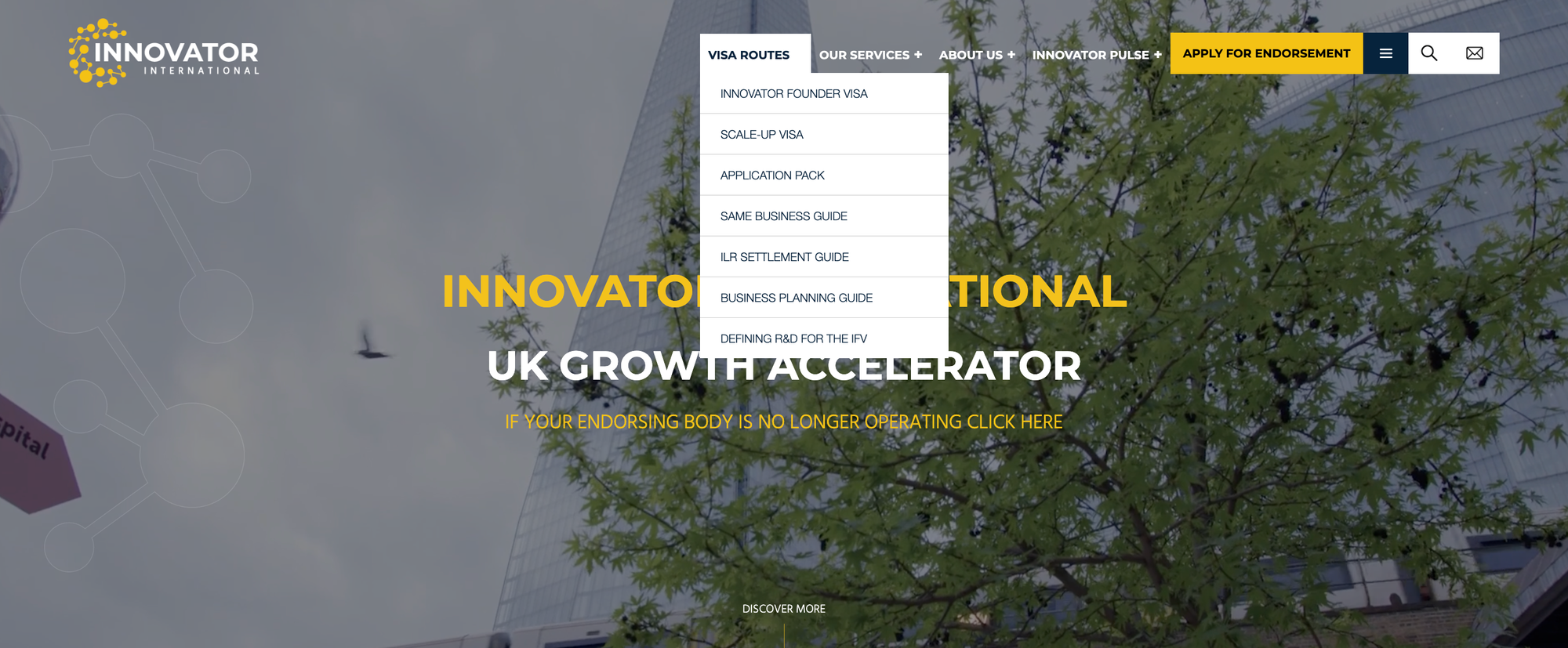
Have you seen our visa routes menu on the Innovator International website? We recommend taking a look! We have worked hard to provide a library of free guides for you, written by the people who assess applications every day.
Think of this article as a tour. We'll take the menu in order, explain what each page or guide is for, and point you to the right one for wherever you are in your journey. Whether you're still sketching an idea on a napkin or getting ready to settle in the UK, there's something in here for you.
Innovator Founder Visa: where most journeys begin
The Innovator Founder Visa page is the front door. It explains that the endorsement is for overseas businesspeople who want to establish an innovative, viable and scalable business in the UK, and it sets out the three questions every application is judged against.
It also lays out the costs in plain terms. The assessment fee is £1k (plus VAT where applicable). If you're successful, there's a £1k monitoring fee after 12 months, and a final £1k assessment if you later apply for settlement or another same business visa. There are no other mandatory costs. It's refreshing to see a fee structure that fits in two sentences, and it's worth knowing before you commit to anything.
Scale-up Visa: a different route for a different kind of business
The Scale-up page is for something quite different. This endorsement is for established UK businesses that don't quite meet the Home Office's usual definition of a scale-up, but have a genuine need to recruit overseas workers through that route.
The business needs to be established in the UK market and able to show it can reach the scale-up requirements within the next four years. The route covers sponsoring people at RQF level 6 and above, and the assessment fee is £1.5k (plus VAT). If you're hiring rather than founding, this is the page for you.


Application Pack: your behind-the-scenes look at the assessment
If you only download one thing before applying, make it the Application Pack. It includes the exact questions assessors use on innovation, viability and scalability, so you can check your plan against them before you submit.
It also covers the practical side. You'll find the documents you need (passport details, business plan, financial projections, CV and evidence of funds), plus the option to upload a short video pitch, which is a lovely chance to show your personality or a prototype. It explains that funds need to be easy to access, and that founders of the same business each apply separately. The usual assessment time is up to 40 days, and if you've heard nothing after 60 days there's a clear way to get in touch.
It's also honest about the limits. Assessment doesn't guarantee an endorsement, the fee is non-refundable, and you must complete and pay for your own application. Reading that now means no surprises later.
Business Planning Guide: turning an idea into a plan people can believe
Most refused applications don't fail because the idea is bad. They fail because the plan doesn't give assessors the information they need. The Business Planning Guide walks you through it in nine sections, from market assessment and product fit to marketing, people, operations, finance and a final review.
What makes it special is how practical it is. It asks you to name the real problem your customers face and what it costs them, and to talk to actual people rather than lean only on statistics. It explains how to build a Gantt chart, score your risks, and put together profit and loss and cash flow forecasts. It even suggests around 30 pages as a sensible length, and saving your plan as a PDF.
Its most reassuring message is that a good plan will expose the weak spots in your idea, and that this is a good thing. Better to find them now than after you've applied. Alongside it, the documents page offers business plan, risk register and project plan templates to download.
Same Business Guide: for when your first visa is nearing its end
If you're coming to the end of your first visa and want to carry on with the same business, the Same Business Guide answers the questions that keep people up at night. Have I made enough progress? What should I prepare? Am I making enough money?
It explains how assessors look at your progress, including what they want to see from your innovative element, your income and your sustainability. It also shows you how to write a progress report of around 5 to 10 pages, with the headings to use. The tone is refreshingly direct. It asks for facts and figures rather than a sales pitch, and it reminds you that changes to your plan should be approved by your endorsing body, not made quietly along the way.
One practical tip stands out. Aim to apply at least two months before your visa expires, and earlier if you can.
ILR Settlement Guide: the road to staying for good
Settlement can feel like a distant finish line, which is exactly why the ILR Settlement Guide is so valuable early on. It explains how Innovator International interprets the Home Office criteria, and it carries a reassuring reminder that ILR isn't expected within three years. Many founders move onto a same business visa first, and that's completely normal.
The guide covers what your business needs to show, including that it's active, trading and sustainable, and that you've made significant achievements against your endorsed plan. It also explains the additional success criteria, of which you need to meet at least two. These include £50,000 invested, a doubled customer base, R&D backed by intellectual property, revenue targets and job creation. For each one it spells out what evidence to bring, and it explains what happens if your application isn't accepted. Reading it early lets you build the right evidence from day one, instead of hunting for it in year three.
Defining R&D for the IFV: our newest guide
The latest addition, published in August 2026, tackles a question that trips up many founders. Is what I'm doing actually research and development? Defining R&D for the IFV explains that creating something new isn't automatically R&D. The key is solving a genuine scientific or technical uncertainty where the answer isn't already obvious.
It offers a simple test. If an experienced professional could solve the problem quickly using what they already know, it probably doesn't count. If they'd need to investigate, experiment and test different approaches, you're much closer. The guide also makes clear that R&D doesn't have to be revolutionary, and that science covers far more than laboratories, from food and sport to behavioural and environmental science.
Its main advice is to document your work as you go, as if you were writing a technical report, rather than trying to rebuild three years of research just before applying. It also explains how to show the outcome, whether through a patent, a registered design or, in suitable cases, an independent report from a recognised specialist.
Why these guides are worth your time
Taken together, the seven items in that menu follow your whole journey, from first idea, to assessment, to progress, to settlement. They're free, they're written by the team that assesses applications, and they tell you what we are looking for in plain language. A founder who has read them walks into the process knowing what to prepare, what to avoid and when to start.
So here's our gentle nudge. Visit our Innovator International website, open the Visa Routes menu, and download the guide that matches where you are right now. Keep the others for later. If you're ready to take the next step, you can apply for endorsement through the site, and if you'd like company along the way, the Innovator Pulse community is here with events, resources and fellow founders who've been exactly where you are.